

Flip the Roborock S5 over and you’re going to find two black rubber wheels on either side, a multi-directional wheel at front, and a three-spoke side brush to the leftside. Between the wheels is the combination rubber and bristle roller brush. Though similar to the brush around the Eufy Robovac 30c, the S5’s roller brush remained free of hair and fuzz. Design The security company AV-Test recently assessed the safety of four different app-connected robot vacuums, including the Roborock S55 and the iRobot Roomba 980. The Roborock S55 performed the worst; AV-Test explained this was”Due partly to gross safety deficiencies in data transmission, the transfer of information to third parties, the app’s unexplainable thirst for data, in addition to a very clear need for progress in the statement on the handling of customer data.” According to a Roborock agent, although the Roborock S5 employs the same program made by Xiaomi since the S55 (Xiaomi is an investor in Roborock), map data is stored locally on the robot and only goes into the Cloud when an individual views the map onto the smartphone program.

As much as 20 maps are saved in the Cloud in any time and so are automatically deleted after a year. When users delete a map in the app, it’s also eliminated in the Cloud. Exactly what the Roborock S5 lacked cleaning thoroughness, it made up for with speed, cleaning our hardwood and carpet test region at an average of 15 minutes and 22 seconds, almost a full hour faster than the Roomba 690 and 45 minutes quickly compared to Shark Ion R85. It was not quite as fast as the Neato Botvac D7, which cleaned the evaluation region in a mean of 10 minutes. We were excited about zone cleaning as it is a wonderful way to perform a daily cleaning of hall or kitchen. From the primary display on the app, you can draw boxes. Unlike the Roomba i7+ and the Neato Botvac D7, you cannot save or title the zones, which usually means you need to redraw the place each time you wish to wash them. Adding to the confusion is a Edit Map button on the main display that allows you draw on virtual barrier cassette and no-go zones. Among our favorite design components of this Robovac S5 is its own”hood” Flip up the bit that is thin and you will find the dustbin hidden in the center, together with a Wi-Fi index light and program reset button.

The S5 was the only real robot vacuum we examined that had an onboard area to hold the differently easy-to-lose instrument for cleaning the brush roll, a clever means to keep while enhancing the aesthetic. An indented section close to the back is meant to hold the microfiber mop module. At 63.8 decibels, the Roborock S5 was clearly louder than the Shark Ion R85 (59.2). We were able to have a conversation although the vacuum worked around us, but raised our voices. The Roborock S5 performed nicely, but not outstandingly so. On hardwood and carpet, it picked up an average of 96.2 percent of those Cheerios strewn throughout the test area, which was marginally less than the iRobot Roomba 690 (99.5 percent), the Neato Botvac D7 (99.8) and the Shark Ion R85, that divides up a perfect 100 percent on this evaluation. The Roborock S5 measures 13.8 inches in diameter, more than an inch bigger than the Shark Ion R85; it’s also larger than the 13-inch iRobot Roomba 690 and the 13.2-inch Neato Botvac D7. Installation and program We were hesitant to provide the S5 free reign to mop in case it decided to test and clean our rug, so we used the spot-cleaning manner, which cleans a 1.5- meter (4.9 feet) area around where the S5 is put. Turns our hesitations were unfounded. The Roborock S5 produced about as much water as a wet Swiffer pad on the ground. If only it had cleaned as well as a Swiffer does.

Security concerns Picking pet hair on both the hardwood and carpeting stymied many of the robot vacuums we tested, including the Roborock S5;it picked up only 79.5 percent of pet hair–10 percent less than the Botvac D7 and 8.5 percent less compared to Ion R85. On the other hand, the S5 did best the Roomba 690’s 73.3 percent pet hair pickup speed. Mopping performance Much like the program that accompanies the Mi Home program, the Eufy Robovac 30C was made to control multiple home devices that were smart. While the vacuum part of the app is strong, the design is not intuitive. All in all, the Roborock S5 accumulated an average of 86.8 percent of test debris on carpeting –a performance on a level with all the Neato Botvac D7, but well below the Shark Ion R85’s 97.2 percent. The S5’s hardwood performance told a similar tale, picking up an average of 83.9 percent of all test debris. The Botvac D7 bested it by 12 percent. The Roborock S5 distinguishes itself with a mapping feature that’s unique among the robot vacuums we tested, but unfortunately, its art is useful. A thin disc using a microfiber pad resides under the rear of the vacuum. Fill out the dish using water, click it in, adjust the Cleanup manner and you are ready to wash. The screen displays the area in yards, cleaning time and also our piece of information. Along the bottom are icons for Go, Dock, Clean and Zoned Cleanup. In the middle of this robot is a laser cap on the Neato Botvac D7 using a splash of underneath, similar to the one. Above the cover are bodily buttons for cleaning, on/off and recharging. Perhaps due to the color, the wall detectors on the front and side of the S5 are more conspicuous than on other versions, but they don’t detract from the bot appearance.

We were amazed with how lightly the Roborock S5 approached walls and barriers. The bumper on the Roomba 690 seemed to announce that it hit something with clunk; the S5 was considerably more considerate. The robot slows its own approach and its brush before gingerly approaching an obstruction when the S5 decided an object was approachable, it approached gusto. The S5 pushed seats and dog bowls around the floor more than the Shark Ion R85 and also the Neato Botvac D7. It was not destructive, but I wouldn’t leave a vase on a plant stand around during a cleaning. Once the Roborock S5 gets its claws, it cleaned regions in a thorough back-and-forth snake pattern. The robot vacuum quickly found its way beneath our dining room table, easily weaving its way from 1 side of the room to another. We appreciated how hewed to walls and around seat legs;it tackled walls and edges tightly as the Neato Botvac D7. The vac was also smart enough to fully avoid a thick pile rug that felled additional robot vacuums, but its taller height supposed it didn’t fit under our seats or our low-clearance couch. Despite its larger size, the Roborock S5 deftly maneuvered through tight spaces. At 3.8 inches high, the S5 sits squarely between the 3.9-inch Botvac D7 and the 3.7-inch Roomba 690. While we do not love the raised laser cover in the center, the feature was less obtrusive than the one on the D7, that has a massive overhang and penchant for becoming stuck beneath room seats. You want it to look if it’s docked in your living space if you’re adding a robot vacuum to your house. The Roborock S5 eschews the black-and-gray color scheme adopted by other vacuums for white, with silver trim around the rim. If you guessed that the Go icon would initiate a cleaning cycle, you’d be wrong. Rather, Go directs the S5 to a user-chosen point on the cleaning map for the bot to perform a spot cleaning. By activating the icon, a vacuuming cycle is initiated. Buried in the Settings menu are five different Cleanup modes : Quiet, Balanced, Turbo, MAX and Mop. The program, and by extension, the vacuum, retains the mode last used.

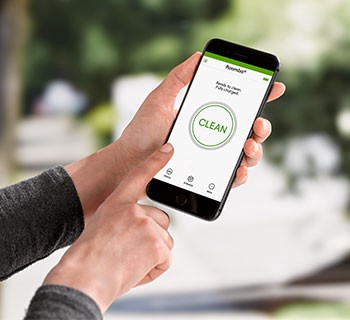
Cleaning performance The Roborock S5 may also be controlled via Amazon Alexa and Google Home. Don’t expect to get any features the only options are On and Away, which prompts to bot to come back to its base. Google Assistant adds”Return to Dock,” which sends the robot home, as opposed to Cease, which pauses the vacuum in its tracks. “Starting the cleanup,” a cheery voice announces from deep inside the Roborock S5. Rather than a string of Morse code-like beeps and chimes employed by the Neato Botvac D7, the Shark Ion R85 and lots of other appliances, the S5 admits what it is likely to perform in easy-to-understand terminology prompts. The Roborock S5 is primarily controlled through the Mi Home app (Android and iOS). Linking the robot into the program and to our house wi-fi network took two attempts , mostly because the directions for pairing the bot into the network were not very apparent. Instructions that were abstruse quickly turned into a motif of the S5. The manual recommends running a vacuum cycle that is regular within the area at least three times. We did this, but it did not appear to help. The S5 left the mapped area dull and somewhat tacky. When it was possible to use something along with water from the mop tank it would have performed better. The black-and-white dock for the Roborock S5 is only slightly taller than the vacuum. It is only needed if you’re planning on utilizing the mop attachment, although A large plastic mat attaches to the pier. Notice that tabbed Saving Mode is currently in beta and have to be toggled on separately under Vacuum Settings in the program. We spent a few test runs re-mapping our floor due to the map not saving automatically. Both the iRobot Roomba and also the D7 can save floor plans.


 Simply Amazing